

| Key Facts About GLP-1 Injection SitesApproved GLP-1 injection sites: abdomen, front/outer thigh, and back of the upper armAll three sites deliver the medication subcutaneously — into the fat layer beneath the skinThe abdomen is the most commonly used site and easiest for self-injectionRotate injection sites weekly to prevent lipohypertrophy (lumpy scar tissue under the skin)Stay at least 2 inches away from the belly button when injecting in the abdomenNever inject into muscle — GLP-1 medications require subcutaneous, not intramuscular, injection |
GLP-1 receptor agonists — including semaglutide (Wegovy, Ozempic) and tirzepatide (Zepbound, Mounjaro) — are administered as subcutaneous injections once weekly. For most patients starting a weight management program, the injection process itself is straightforward once technique is established. The questions that come up most often are practical: where exactly to inject the medication, how to rotate correctly, and what to do when an injection site becomes uncomfortable or develops a reaction. The site selection and rotation principles are identical for both medications — for full detail on how semaglutide doses escalate from 0.25 mg to the 2.4 mg maintenance dose, see the GLP-1 semaglutide dosage for weight loss guide.
This guide covers the three FDA-approved GLP-1 injection sites — abdomen, thigh, and upper arm — with a comparison of each, a step-by-step injection guide, and the injection mistakes that most frequently affect absorption and skin health over time. For patients who want a broader overview of how GLP-1, GIP, and other injectable medications differ from one another, the types of weight loss medication injections guide covers the mechanism and clinical distinctions in detail.
Core Primary Care physicians supervise GLP-1 weight loss programs in Houston, Sugar Land, and Katy, TX — providing hands-on injection training at the start of treatment and ongoing dose management throughout.
| Quick Clinical AnswerThe best place to inject GLP-1 medications like semaglutide and tirzepatide is the abdomen — at least 2 inches away from the belly button, in the soft fatty tissue to the side or below the navel. The front or outer thigh is an equally effective alternative. The back of the upper arm works well but is harder to self-inject. All three sites deliver the medication into subcutaneous fat, producing consistent absorption. Rotating injection sites weekly prevents lipohypertrophy — the most common complication of repeated injections in the same spot. |
Does Injection Site Matter for GLP-1 Medications?
The short answer: site selection matters less than site rotation. All three approved GLP-1 injection sites deliver the medication into subcutaneous fat — the fatty tissue beneath the skin — which is the intended tissue for these drugs. GLP-1 medications are not designed for intramuscular injection, and injecting into muscle rather than the fat layer beneath the skin can alter the absorption rate, increase discomfort, and may reduce efficacy. For patients interested in how different types of injectable weight loss medications compare in mechanism and formulation, the types of weight loss medication injections article covers this in depth.
Published pharmacokinetic data on semaglutide and tirzepatide shows that absorption from different subcutaneous sites is broadly similar. The abdomen may produce marginally faster absorption in some patients, but the clinical significance of this difference is small and does not consistently translate to better weight loss outcomes. What consistently matters is proper injection technique and rotating injection sites to prevent the skin changes that affect how reliably the medication absorbs over time.
How Subcutaneous Injection Works
A subcutaneous injection delivers medication into the layer of fatty tissue directly beneath the skin — the subcutaneous tissue — rather than into a vein or muscle. GLP-1 medications dissolve into this fat layer and are absorbed gradually into the bloodstream via small capillaries, producing the slow, sustained release profile that allows once-weekly dosing to work.
Correct technique means the needle tip sits in subcutaneous fat — not in the dermis (too shallow) and not in underlying muscle (too deep). The 90-degree angle insertion used with GLP-1 auto-pen devices is designed to reach this layer reliably in most adults. Very lean patients may benefit from pinching the skin to create a fold — this reduces the risk of inadvertent intramuscular injection and helps confirm the needle tip is beneath the skin in the correct tissue layer.
GLP-1 Injection Sites: Abdomen, Thigh, and Upper Arm Compared
The table below summarises the practical differences between the three approved injection sites. All three are clinically appropriate — the right choice depends on your body composition, ease of access, and personal preference.
| Site | Pros | Cons | Best For |
| Abdomen | Largest surface area; easiest self-injection; consistent absorption | Stay 2 inches from belly button; more sensitive for some | Most patients — especially self-injecting |
| Front/outer thigh | Easy to see and reach; reliable fat layer; less sensitivity | Slightly slower absorption in some; avoid inner thigh | Patients who find abdomen uncomfortable |
| Back of upper arm | Discreet; good fatty tissue layer | Harder to self-inject; needs assistance for most | Patients with caregiver support or clinic-administered doses |
GLP-1 Injection Site in the Abdomen
The abdomen is the most commonly used injection site for GLP-1 medications and the easiest to self-administer for most patients. The surface area available — between the lower ribs and hip bones, to either side of the navel — is larger than the thigh or arm, giving more rotation options and reducing how often any single spot is reused.
When injecting in the abdomen: stay at least 2 inches away from the belly button in every direction. The tissue immediately around the navel is denser and less vascular, and injections close to it are more likely to cause bruising, poor absorption, and discomfort. Inject at least 2 inches away from your belly button — ideally to the side or below the navel — and rotate within this area systematically rather than always returning to the same quadrant.
GLP-1 Injection Site in the Thigh
The front thigh — specifically the front or outer surface of the upper leg — is the most common alternative to the abdomen. The front or outer thigh surface has a reliable layer of subcutaneous fat in most patients and is easy to see and reach for self-injection.
The instruction to avoid the inner thigh is consistent across all GLP-1 prescribing guidance. The inner surface has less fatty tissue, more nerve endings, and is more likely to produce injection discomfort. Use only the front or outer surface — roughly where your hand rests if you place it flat on the front of your thigh.
GLP-1 Injection Site in the Upper Arm
The back of the upper arm — the triceps region — is an approved site but the most challenging to self-administer. The angle and depth are harder to control without a direct line of sight. For patients with a caregiver or clinical support, it is a valid third site that expands rotation options without needing to return to the abdomen or thigh as frequently.
Target the soft tissue on the back surface of the upper arm, midway between the shoulder and elbow. Avoid the bony areas near the shoulder joint and elbow. Press the pen firmly and hold still for the full dose delivery period — arm tissue shifts more with movement than the abdomen or thigh.
Site Rotation: Why It Matters and How to Rotate Injection Sites
Site rotation is a clinical requirement for patients on long-term GLP-1 therapy — not an optional best practice. Lipohypertrophy — hard, lumpy subcutaneous scar tissue from repeated injections in the same spot — is the most common skin complication associated with weekly subcutaneous GLP-1 injections and with insulin therapy.
When lipohypertrophy develops, the affected tissue becomes fibrous and poorly vascularised. Medication injected into it absorbs unpredictably — producing erratic drug levels and inconsistent appetite suppression. Patients who have injected without rotating sites sometimes notice their medication feels less effective; in a number of these cases, lipohypertrophy is the explanation. It is reversible if caught early — but the area needs months of rest from injections to recover.
How to Rotate Injection Sites
The rotation principle is to move both within a body region (at least 1-2 inches from the previous injection spot each week) and between body regions over time. A practical approach:
- Divide the abdomen into four quadrants: upper left, upper right, lower left, lower right — rotate through them in sequence
- Within each quadrant, move at least 1-2 inches from the spot used the previous week
- When rotating to the thigh, alternate left and right legs
- Keep a brief record — a phone note with the date and site used is sufficient
- Never inject into an area that feels hard, lumpy, or tender — these are signs of lipohypertrophy or active bruising that needs time to resolve
Rotating sites weekly — the correct cadence for once-weekly GLP-1 medications — gives each injection area 3-4 weeks of recovery before being used again. This is sufficient to prevent chronic lipohypertrophy when rotation is consistent.
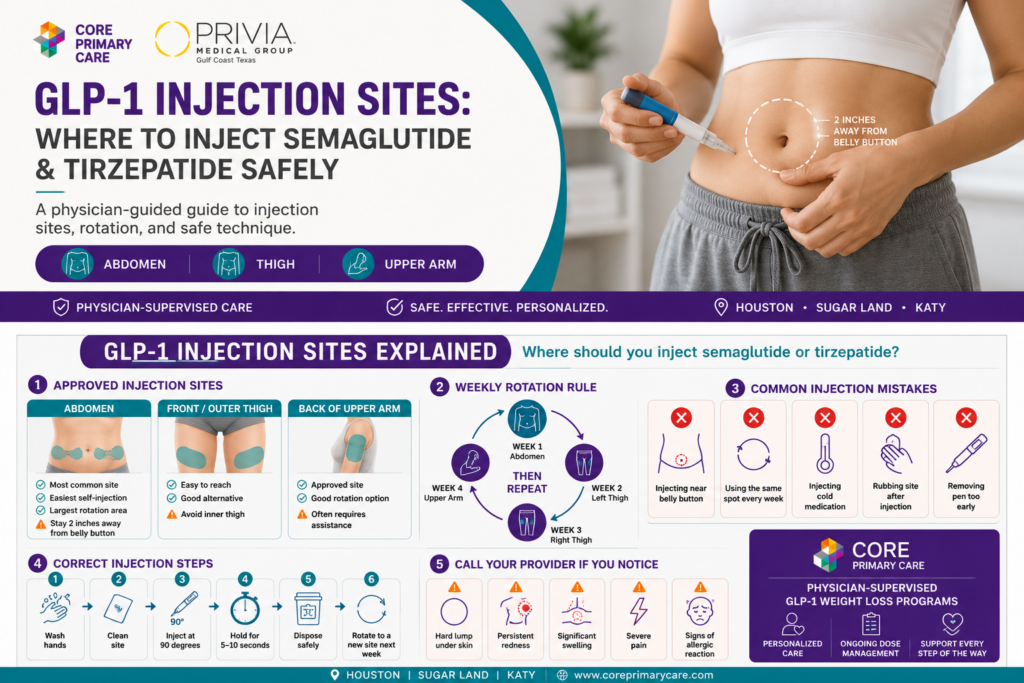
Step-by-Step Guide: How to Inject GLP-1 Medication Correctly
The following step-by-step guide applies to both semaglutide (Wegovy, Ozempic) and tirzepatide (Zepbound, Mounjaro) when using a pen auto-injector device. If you are using a manual syringe — as with some compounded preparations — the injection technique is the same, but preparation steps differ; follow the specific instructions from your prescribing physician.
| Step | Action | Key Detail |
| 1 | Wash hands thoroughly with soap and water | Do this before handling the pen or touching the injection area |
| 2 | Remove pen from refrigerator 15-30 min before injection | Room-temperature medication is more comfortable than cold |
| 3 | Check pen — confirm medication is clear, not cloudy or discoloured | Do not inject if the solution looks unusual — contact your pharmacy |
| 4 | Select and clean injection site with alcohol swab | Let the area dry fully — 10-15 seconds — before injecting |
| 5 | Pinch the skin gently if instructed (especially for leaner patients) | Creates a small fold to target subcutaneous fat, not muscle |
| 6 | Insert needle at 90-degree angle, press pen button slowly and steadily | Hold in place until full dose is delivered — usually 5-10 seconds |
| 7 | Remove needle, apply gentle pressure — do not rub | Rubbing can cause bruising or affect medication absorption |
| 8 | Dispose of needle in sharps container immediately | Never recap or leave used needles exposed |
| 9 | Rotate to a different site next week | Record which site you used to track rotation |
A note on compounded semaglutide: compounded versions are typically supplied in vials requiring manual syringe loading rather than auto-pens. Be aware that compounded formulations are not FDA-approved products and may carry manufacturing variability risks that FDA-approved injection devices do not. For a detailed walkthrough of the full injection process — including how to handle missed doses and pen malfunctions — see the how to inject GLP-1 weight loss medications guide.
Does the GLP-1 Injection Hurt?
Most patients report that GLP-1 injections cause minimal discomfort when technique is correct. The needle in modern auto-pen devices is very fine — typically 4-6 mm — and the injection takes only a few seconds. Allowing the medication to reach room temperature before injecting reduces the cold sting some patients notice. Letting the alcohol swab dry fully before inserting the needle also reduces the sharp sensation associated with alcohol contact with broken skin.
A small amount of bruising or temporary redness at the injection site is normal. Consistent bruising at the same site — or hard lumps that do not resolve within 1-2 weeks — indicates insufficient rotation and the need to rest that area.
Injection Site Reactions: When to Contact Your Healthcare Provider
Most injection site reactions are mild and self-resolving: a small red mark, minor bruising, brief itching. These are common, particularly in the first weeks of treatment or after dose escalation, and are not a reason to stop the medication.
Contact your healthcare provider if you notice any of the following:
- A hard lump or raised area that does not resolve within 2-3 weeks — possible lipohypertrophy
- Significant swelling, warmth, or redness expanding beyond the immediate injection area — possible infection
- A bruise that is unusually large or does not fade over 7-10 days
- Persistent pain at the injection area disproportionate to a normal post-injection response
- Signs of allergic reaction: hives, facial or throat swelling, difficulty breathing — seek emergency care immediately
Always consult a licensed healthcare provider if you are uncertain about any skin change at an injection site. Untreated lipohypertrophy is progressive — the longer injections continue in affected tissue, the more fibrous it becomes and the harder it is to restore normal absorption.
Common GLP-1 Injection Mistakes to Avoid
The injection mistakes that most frequently cause problems are not errors of intention — they are gaps in technique that accumulate over weeks of self-injection without correction:
- Injecting too close to the belly button (less than 2 inches away) — reduces absorption and increases bruising risk
- Not rotating sites — the leading cause of lipohypertrophy in long-term subcutaneous therapy
- Injecting cold medication straight from the refrigerator — increases discomfort unnecessarily
- Rubbing the injection site after — causes bruising and may affect medication absorption
- Not letting the alcohol swab dry before injecting — amplifies the sting and can cause skin irritation
- Removing the pen too quickly after pressing the button — the full dose is delivered over 5-10 seconds; pulling away early means incomplete dosing
- Injecting into the inner thigh rather than the front or outer surface — more painful, less subcutaneous fat
- Using the same abdominal quadrant for every injection — still causes lipohypertrophy even if the precise spot shifts slightly
For patients with questions about injection technique mid-program, Core Primary Care’s medical weight loss program includes physician oversight and injection technique review at any scheduled visit — this is a standard part of supervised care, not a special request.
Frequently Asked Questions
What is the best place to inject GLP-1 medications?
The best place to inject GLP-1 medications is the abdomen — specifically the soft fatty tissue at least 2 inches away from the belly button, to the side or below the navel. This site is easiest to self-inject, offers the largest surface area for rotation, and produces reliable absorption. The front or outer thigh is an equally effective alternative. The back of the upper arm is approved but harder to reach without assistance.
Is the thigh or stomach better for semaglutide?
Both produce clinically comparable absorption of semaglutide. The stomach (abdomen) is generally preferred for self-injection because it offers more space for rotation and is easier to see and access. Some patients prefer the thigh if they have sensitivity around the abdomen. The more important factor is rotating between sites weekly and using correct injection technique at whichever site you choose.
Does injection site affect weight loss results?
The injection site itself does not meaningfully affect weight loss outcomes when all three approved sites are used correctly. What affects results over time is injecting into lipohypertrophyic tissue — the scar tissue from repeated injections in the same spot — which reduces reliable medication absorption. Consistent site rotation prevents this and helps maintain predictable drug levels throughout treatment.
Which GLP-1 injection site hurts the least?
Most patients report that abdominal GLP-1 injections are relatively painless with correct technique — a fine needle, room-temperature medication, and a dry alcohol swab. Some find the outer thigh less sensitive than the abdomen. The inner thigh is consistently more uncomfortable and should be avoided. The back of the upper arm is also generally comfortable when positioned correctly.
Can I switch injection sites every week?
Yes — rotating to a different site each week is the recommended approach for once-weekly GLP-1 medications. Switching sites weekly gives each area 3-4 weeks of recovery before being used again. You can rotate between abdomen, thigh, and arm in any order. Within the abdomen, also rotate between quadrants — do not always use the same area on the left or right side, even when rotating between body regions.
What is lipohypertrophy and how do I prevent it?
Lipohypertrophy is hard, lumpy subcutaneous scar tissue caused by repeated injections in the same location. Medication injected into it absorbs unpredictably, which can reduce the effectiveness of your GLP-1 program. Prevention is straightforward: rotate sites consistently, move at least 1-2 inches from the previous injection spot, and never inject into an area that already feels hard or lumpy.
Can semaglutide and tirzepatide be injected in the same areas?
Yes. Semaglutide and tirzepatide both use the same three approved injection sites: abdomen, front/outer thigh, and back of the upper arm. The rotation principles are identical for both medications. The devices differ — Novo Nordisk auto-pens for Wegovy and Ozempic, Eli Lilly devices for Zepbound and Mounjaro — but the injection technique is the same regardless of which medication you are using.
What should I do if I inject too close to my belly button?
If you accidentally inject within 2 inches of the belly button, monitor the site for 24-48 hours. Some additional bruising or soreness is possible. The medication will still absorb, though absorption may be less predictable in the dense tissue near the navel. For your next injection, return to the correct area — at least 2 inches away from the belly button. If the area develops significant swelling, persistent pain, or a hard lump, contact your healthcare provider.
Key Takeaways
- The three approved GLP-1 injection sites are the abdomen, front/outer thigh, and back of the upper arm — all deliver medication into subcutaneous fat.
- The abdomen is the best place to inject for most patients: largest surface area, easiest self-injection, consistent absorption.
- Always stay at least 2 inches away from the belly button when injecting in the abdomen.
- Rotate injection sites weekly — failure to rotate causes lipohypertrophy, which reduces medication absorption and can blunt treatment results.
- Avoid the inner thigh — use only the front or outer surface of the upper leg.
- Allow medication to reach room temperature, let the alcohol swab dry, and hold the pen in place for the full 5-10 seconds until the full dose is delivered.
- Contact your healthcare provider if you develop a hard lump, expanding redness, or persistent pain at any injection site.
- Core Primary Care provides supervised GLP-1 weight management in Houston, Sugar Land, and Katy, TX — including injection technique review at any point during treatment.
| GLP-1 Weight Loss Programs at Core Primary CareCore Primary Care supervises GLP-1 weight loss programs — including semaglutide and tirzepatide — with physician oversight, injection training, and ongoing dose management. Accepting new patients in Houston, Sugar Land, and Katy, TX.Start your program: Medical Weight Loss at Core Primary Care | Weight Loss in Sugar Land | Weight Loss in Katy |